The Substitute Teacher Who Accidentally Built America's Most Unbreakable Dynasty
The Coach Who Wasn't Supposed to Win
In the fall of 1979, De La Salle High School in Concord, California, needed someone to coach their struggling football team. They had exactly one applicant: Bob Ladouceur, a 25-year-old substitute teacher with zero coaching experience who had played exactly one year of college baseball before focusing on his education degree.
 Photo: Concord, California, via thumbs.dreamstime.com
 Photo: De La Salle High School, via www.msxlabs.org
 Photo: Bob Ladouceur, via ecdn.teacherspayteachers.com
The hiring committee wasn't optimistic. De La Salle was a small Catholic school competing against much larger public schools with established programs and experienced coaches. They needed someone who could at least keep the team competitive, maybe win a few games each season.
What they got instead was the most improbable dynasty in American sports history.
Building Something Different
Ladouceur's first season was exactly what everyone expected: the team went 1-8. His second season wasn't much better. But instead of focusing on what his players couldn't do – they weren't the biggest, fastest, or most naturally talented kids in the league – he started asking a different question: what could they become together?
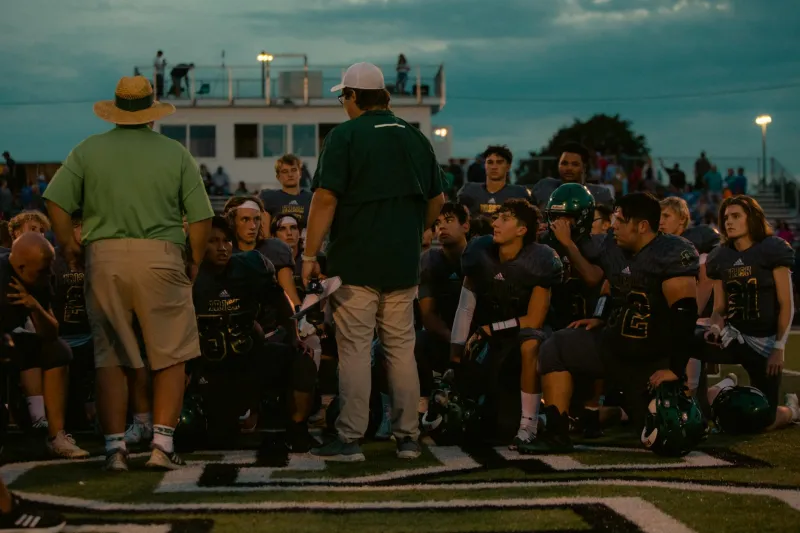
While other coaches were drawing up complex playbooks and drilling fundamentals, Ladouceur was having conversations that sounded more like therapy sessions than football practice. He asked players to talk about their fears, their family problems, their dreams beyond high school. He made them write letters to themselves about what kind of men they wanted to become.
Other coaches thought he was wasting time. How does talking about feelings help you tackle better or run faster?
The answer would become clear soon enough.
The Philosophy That Broke the Game
By his third season, something had shifted. The team wasn't just playing better football – they were playing like a single organism. Players anticipated each other's movements with an almost telepathic precision. They made sacrifices for teammates that went far beyond normal team chemistry.
Ladouceur had stumbled onto something that conventional coaching wisdom missed entirely. Football, he realized, wasn't really about individual talent or even tactical superiority. It was about trust, commitment, and the willingness to subordinate personal glory for collective success.
His practices became laboratories for building these qualities. Players had to complete tasks that required absolute dependence on teammates. They learned each other's personal stories, family backgrounds, and individual struggles. They were required to hold each other accountable not just for football performance but for academic achievement and personal character.
It sounded soft to outsiders, but the results were anything but.
The Streak That Defied Logic
On September 11, 1992, De La Salle beat Pittsburg High School 35-27. It was their 13th consecutive victory – a nice little winning streak for a program that had been rebuilding.
Twelve years and four months later, they were still winning.
The streak reached 50 games, then 75, then 100. Sports Illustrated sent reporters. ESPN cameras showed up at practices. College coaches and NFL scouts began studying Ladouceur's methods, trying to decode what seemed impossible.
De La Salle wasn't recruiting blue-chip athletes. They weren't using revolutionary training methods or secret plays. They were a small Catholic school in suburban California, playing with kids who were good but not great, coached by a man who had never played high school football himself.
Yet they kept winning. And winning. And winning.
The Science of the Impossible
Sports researchers from Stanford, UC Berkeley, and other universities began studying the De La Salle program, trying to understand how a 151-game winning streak was even mathematically possible. Their findings were as puzzling as the streak itself.
Statistically, even the best teams should lose occasionally due to random factors: injuries, bad weather, referee calls, or simply the law of averages. Computer models suggested that a team would need to be approximately 95% better than their average opponent to maintain such a streak – a level of dominance that shouldn't exist in high school sports.
But the deeper researchers dug, the more they realized that Ladouceur had created something that transcended normal competitive dynamics. His players weren't just better prepared; they were operating from a completely different psychological framework.
The Method Behind the Magic
What made De La Salle different wasn't their X's and O's – though they executed fundamentals flawlessly. It wasn't their physical conditioning – though they were superbly prepared. It was their approach to pressure, failure, and success.
Ladouceur taught his players to view each game not as a test of their worth but as an opportunity to express their commitment to each other. Winning wasn't the goal; playing with complete integrity and effort was the goal. Winning was just what happened when you did that consistently.
This philosophical shift had practical effects that other coaches couldn't replicate. De La Salle players didn't choke in big games because they weren't playing for external validation. They didn't get overconfident during easy games because their focus was on process, not results. They didn't fall apart when they made mistakes because their identity wasn't tied to perfection.
They had, in essence, been immunized against the mental errors that derail most teams.
The Dynasty That Taught Itself
Perhaps the most remarkable aspect of the De La Salle program was how it became self-sustaining. Older players mentored younger ones not just in football techniques but in the program's philosophical approach. The culture became so strong that it recruited and shaped players more effectively than any coaching staff could.
Bythe time the streak reached triple digits, Ladouceur was barely coaching in the traditional sense. He had created a system that coached itself – a culture so deeply embedded that it persisted regardless of individual personalities or external pressures.
College and professional teams sent representatives to study this phenomenon. They took notes, interviewed players and coaches, and tried to implement similar approaches. None of them came close to replicating the results.
The End and the Beginning
On September 4, 2004, De La Salle lost to Bellevue High School from Washington, 39-20. The streak was over at 151 games. Players cried. Coaches were stunned. The sports world exhaled collectively.
But something interesting happened next: De La Salle kept winning. Not at the same impossible rate, but consistently, year after year. The program Ladouceur had built survived the end of the streak because it had never really been about the streak at all.
The Lesson That Couldn't Be Taught
Today, Bob Ladouceur's methods are studied in business schools, military academies, and leadership programs around the world. His approach to building trust, commitment, and shared purpose has applications far beyond football.
But the most important lesson from De La Salle isn't about coaching techniques or team-building exercises. It's about what becomes possible when someone approaches a familiar challenge from a completely unfamiliar angle.
Ladouceur succeeded precisely because he didn't know how football coaching was "supposed" to work. He wasn't constrained by conventional wisdom about motivation, strategy, or player development. He was free to invent something new because he didn't know what was impossible.
The substitute teacher who never meant to be a coach ended up teaching the entire sports world something it didn't know it needed to learn: that the most unbreakable dynasties aren't built on talent or tactics, but on trust. And sometimes the person least qualified for the job turns out to understand the job better than anyone else.