No Money for a Lawyer, So She Learned to Be One
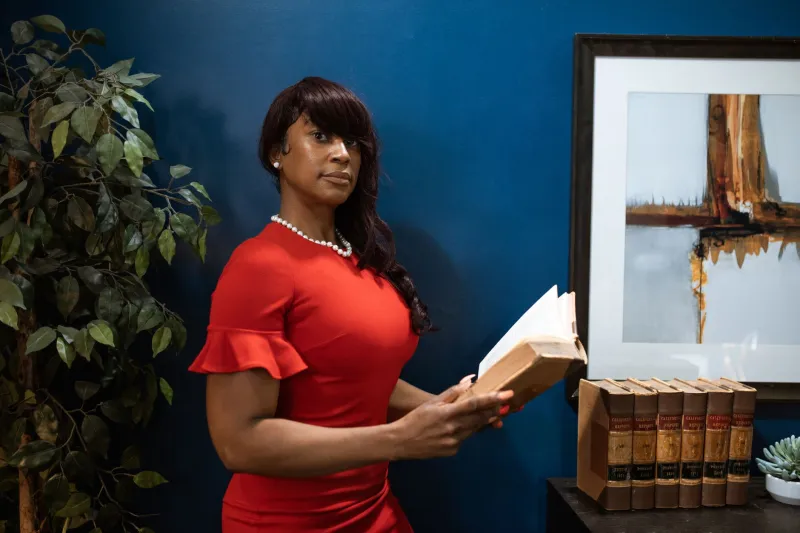
The first law book Vivienne Marsh ever read had a cracked spine and somebody else's name written inside the cover. She found it on a shelf in a prison library in the mid-1960s, pulled it down because she had nothing else to do that afternoon, and opened it to a random page. She didn't understand most of what she read. But she understood enough to realize that the system that had put her in that room had made at least two procedural errors she could now name.
That was the beginning.
How You End Up in a Room Like That
Vivienne grew up in rural Georgia, the youngest daughter of a janitor and a seamstress who worked themselves thin keeping four kids fed and clothed. College wasn't a conversation anyone had in her house — not because her parents didn't value education, but because the economics of their lives didn't leave room for that kind of dreaming. She was smart, her teachers said so, but smart didn't pay rent.
She moved north in her early twenties, part of the tail end of the Great Migration, landing in a Cincinnati neighborhood where the promises of the industrial North had already started to curdle. She worked. She got into trouble — not violent trouble, but the kind of low-level legal entanglement that tends to follow people without resources, without connections, without anyone to call when things go sideways. A series of charges, some legitimate, some questionable, and a public defender she met for eleven minutes before her hearing.
She got two years.
The Education Nobody Planned
The prison library was small and underfunded, which is the kindest way to describe most prison libraries in 1960s America. But it had law books — donated, outdated, marked up by previous readers — and Vivienne Marsh read every one of them.
She was methodical about it in a way that surprised even her. She kept notes in a composition book. She made herself look up every word she didn't understand. She read cases and then tried to identify the argument underneath the argument — the real question being asked beneath the legal language. It was slow, grinding work, and she'd be the first to tell you she got a lot of it wrong at first.
But she kept going. After her release, she enrolled in every correspondence course she could find, scraping together fees from waitressing shifts and occasional clerical work. She wrote to law professors with questions. Most didn't write back. A few did, and those exchanges became informal tutorials she treasured like currency.
She couldn't get into law school — the barriers facing Black women in the late 1960s and early 1970s were structural and relentless — so she built her legal education in the margins of the system, the way you build anything when the front door is locked. Sideways. Quietly. With whatever tools you can reach.
The Outsider Advantage
Here's the thing about learning law the way Vivienne learned it: you don't absorb the assumptions.
Law school, at its best, teaches you to think like a lawyer. At its worst, it teaches you to think like the lawyers who came before you — to accept the frameworks, to work within the grooves already worn into the system. Vivienne had none of that conditioning. She came to legal problems cold, without the professional instinct to wave off certain arguments as settled or unwinnable.
That made her dangerous in a courtroom, in the best possible sense.
She began working informally as a legal advocate in her community through the early 1970s, helping neighbors navigate housing disputes, benefits denials, and encounters with law enforcement. She wasn't practicing law in the licensed sense — she was careful about that distinction — but she was doing something arguably more valuable: she was translating a system that most of her neighbors couldn't read, and she was finding the cracks.
Eventually, through a combination of grandfathering provisions, bar examination reforms, and the advocacy of a civil rights attorney who recognized what she was capable of, Vivienne Marsh passed the bar in Ohio in 1976. She was forty-one years old.
The Case That Went All the Way
The details of the cases that eventually carried Vivienne's name toward the Supreme Court are less important than the fact of her presence there — a woman who had once sat in a prison library teaching herself the difference between a motion and a brief, now standing in the most consequential courtroom in the country.
The cases involved procedural due process questions in public benefits administration — technical-sounding stuff that had enormous practical consequences for poor families. Vivienne had been fighting versions of this fight for years at the local and appellate levels, and she had developed a clarity of argument that came directly from her unusual vantage point. She wasn't arguing in the abstract. She was arguing for people she had been.
She argued twice before the Supreme Court in the 1980s. She won once, lost once. The loss, she said later, taught her more.
What Desperation Builds
Vivienne Marsh's story gets told sometimes as a triumph-over-adversity narrative, and it is that. But it's also something more specific and more interesting: it's a story about what happens when someone has no choice but to understand a system completely, because partial understanding isn't enough to survive.
The lawyers she faced in courtrooms had gone to good schools and worked at good firms. They knew the law the way you know a house you grew up in — by feel, by habit, without always being able to explain why you turn left at the landing. Vivienne knew it the way you know a house you had to break into: every lock, every window, every place the frame didn't quite fit the wall.
She ran a small civil rights practice in Cincinnati until she retired in 2001. She mentored dozens of young lawyers, particularly women and people of color who felt like outsiders in the profession. She always told them the same thing: the fact that you don't belong here yet is not the same as the fact that you can't.
She passed away in 2009. Her composition notebooks — the ones she filled in that prison library, crammed with definitions and questions and half-understood case summaries — are held by a small civil rights archive in Ohio.
They look exactly like what they are: the beginning of something nobody saw coming.