His Lines Went Nowhere. That Turned Out to Be the Whole Point.
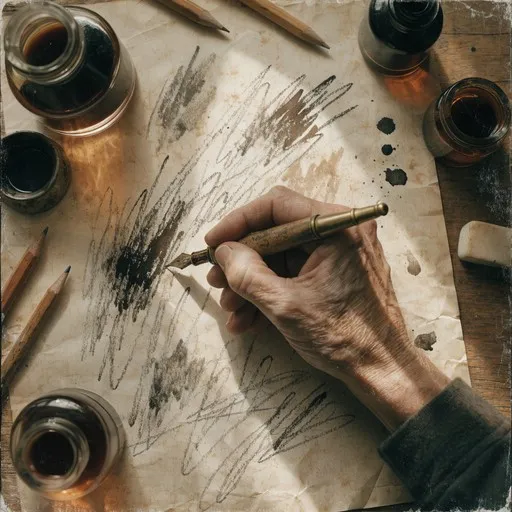
Photo: vintage artist sketchbook expressive hand-drawn ink illustration gestural drawing, via images.stockcake.com
The Tremor That Wouldn't Quit
He used to joke that his hands had their own opinions. The tremor had been with him since his early twenties — not debilitating, not the kind that ends careers outright, but persistent enough to make the precise, controlled linework that serious illustration demanded feel like a daily argument he kept losing. He'd trained in the traditional way: careful observation, measured strokes, the slow accumulation of technical discipline. He was good at the theory. His hands, though, had other plans.
For a few years he fought it. He braced his wrist against the table. He worked in short bursts, resting between strokes. He tried different tools — finer nibs, broader brushes, anything that might hide the wobble or work around it. Nothing worked well enough. The tremor was always there, a low hum of interference in everything he produced.
What happened next wasn't a breakthrough so much as an exhausted surrender. One afternoon, somewhere around 1931, he stopped correcting and started following.
He let the line go where his hand wanted to take it.
What "Wrong" Looks Like Up Close
The first drawings he made this way looked, to his own eye, like failures. The lines wandered. Forms that were supposed to be solid broke apart at the edges. Figures had a nervous, vibrating quality — not quite there, not quite gone. He set them aside, embarrassed.
Then he looked at them again a week later, and something was different. Not in the drawings. In him.
The wandering lines had caught something that his careful, corrected work never had. There was energy in the wobble. The figures felt like they were in motion even when they were standing still. The broken edges suggested depth and atmosphere in a way that clean outlines simply couldn't — because clean outlines, he was starting to understand, were a kind of lie. The world didn't have outlines. The world had transitions.
He started working this way deliberately. Not randomly — he was still composing, still thinking hard about what he was trying to say — but he stopped treating his hand's natural movement as a problem to be solved. He started treating it as information.
A Style With No Name Yet
For a while, what he was doing didn't have a category. The mainstream illustration world of the 1930s prized a certain kind of polished commercial precision — the kind that looked good in magazine spreads and advertising layouts, where clarity was currency. His work looked nothing like that. It looked agitated. Alive. Occasionally, to unsympathetic eyes, it looked unfinished.
He couldn't get regular illustration commissions. The work was too strange for most editors, too rough for the clients who wanted something reassuringly smooth. He sold what he could to smaller publications, experimental literary journals, the occasional avant-garde gallery show where the audience was at least willing to look twice.
What he was developing, without fully realizing it, was a visual language built around incompleteness — around the suggestion of form rather than its declaration. Lines that implied rather than defined. Marks that invited the viewer's eye to do some of the work. It was, in retrospect, a deeply modern idea. In the early 1930s, it mostly just made art directors nervous.
When the World Caught Up
The shift happened gradually, then suddenly — the way most cultural shifts do. Abstract expressionism was building steam. Readers and viewers were becoming more comfortable with images that didn't explain themselves completely. The nervous, gestural quality that had made his work seem undisciplined started reading, in a new context, as sophisticated.
A retrospective of his work in the mid-1940s drew reviews that used words like "pioneering" and "prescient." An art critic in New York — the kind whose opinions actually moved markets — wrote that his line work had anticipated by a decade the gestural freedom that was only now becoming fashionable. Younger artists started showing up at his studio, wanting to understand how he'd gotten there.
He told them the truth: his hands shook, and he'd eventually stopped arguing about it.
Some of them thought he was being modest. He wasn't.
The Technique That Traveled
What he had developed out of necessity became, in the hands of the artists who studied and adapted it, a genuine methodology. The idea that mark-making didn't need to be controlled to be meaningful — that the body's own rhythms could carry expressive information — filtered into illustration, into animation, into graphic design. You can find its descendants in mid-century children's book illustration, in the loose, gestural advertising art of the 1950s and '60s, in the work of artists who never knew his name but were working in a tradition he'd helped establish.
Art schools began teaching versions of what he'd stumbled into. "Gestural drawing" became a formal concept, a thing you could put on a syllabus. The tremor that had once made him feel like a fraud became, in the language of pedagogy, a technique.
He lived long enough to find that deeply funny.
The Lesson the Wobble Taught
There's a version of this story where he gets the tremor treated, the shaking stops, and he spends his career producing perfectly competent, utterly forgettable illustration work. The constraint is removed. The innovation never happens. The methodology that influenced a generation goes undiscovered because the problem that generated it was solved before it could become useful.
Constraints, it turns out, have a way of doing that. They close certain doors so completely that you stop staring at them and start looking at the walls — and sometimes the walls are where the interesting stuff is hiding.
His lines went nowhere a controlled hand would have taken them. They went, instead, exactly where they needed to go.