What the Banks Wouldn't Touch, the Neighborhood Devoured: One Woman's Kitchen Table Empire
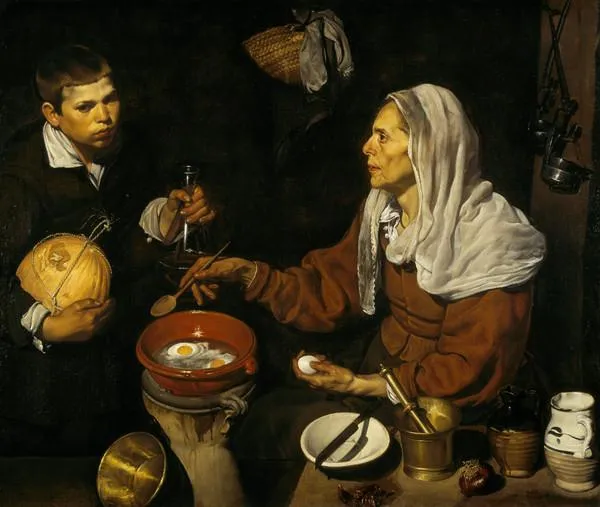
Photo: Diego Velázquez, Public domain, via Wikimedia Commons
There's a particular kind of courage that doesn't look like courage at all. It looks like waking up at four in the morning to start the beans. It looks like hauling a folding table to the corner because the garage is too small for the crowd that's started showing up. It looks like a woman who speaks halting English explaining, in careful and determined sentences, that she would like a small business loan — and being told, again, that she does not qualify.
Rosa Mendez has been told no in two languages. She kept cooking in both of them.
The Record That Followed Her
Mendez arrived in the United States from Oaxaca in the late 1990s, part of a wave of migration driven by economic collapse in rural Mexico. She came with her two youngest children, a phone number for a cousin in Chicago, and a criminal record — a single conviction from years earlier, the kind of thing that sounds simple to explain and is nearly impossible to move past in a country that runs background checks on everything.
She found work where she could. Cleaning offices. Watching other people's children. Helping in restaurant kitchens where the owners weren't too particular about paperwork. She was efficient, tireless, and possessed of a culinary instinct that her coworkers noticed even when the bosses didn't. She could taste a mole and tell you what it was missing. She could stretch a budget across a week of meals that would make a nutritionist weep with appreciation.
But formal employment — the kind with benefits and stability and a path to something better — kept slipping out of reach. The record. The language barrier. The particular bureaucratic cruelty of systems that claim to welcome immigrants while quietly building walls inside every door.
So she stopped looking for a door and made her own opening.
The Garage That Fed the Block
It started, as so many remarkable things do, with a neighbor's request. A woman down the street asked if Mendez could prepare food for a quinceañera — nothing elaborate, just the kind of cooking that tasted like home. Mendez said yes, charged almost nothing, and produced a spread that had people asking for her number before the party was over.
Within a month, she was cooking out of her garage on weekends. Within three months, she had a waiting list. The garage gave way to a tent in the driveway. The tent gave way to a borrowed church hall on Saturdays. The church hall gave way, eventually and inevitably, to an actual space — a shuttered diner two blocks from her apartment that a sympathetic landlord agreed to lease on terms that a bank would never have approved.
She didn't have a loan. She had a community that had watched her work and decided to bet on her with their own money, their own labor, their own time. Neighbors helped paint. Someone's brother-in-law fixed the plumbing for cost. A local grocery supplier started extending her informal credit because her payment record was, in his words, "better than half my actual accounts."
La Mesa de Rosa opened on a Tuesday in 2004. By Thursday, there was a line.
The Competitive Advantage No Consultant Predicted
What Mendez had built wasn't just a restaurant. It was a cultural institution — a place where Oaxacan families could eat food that tasted like the grandmother's kitchen they'd left behind, where the Spanish was warm and unhurried, where you didn't feel like a customer so much as a guest. In the language of business school, she had identified an underserved market and met it with a differentiated product. In the language of the neighborhood, she had simply cooked the food people missed.
The distinction matters less than the outcome. La Mesa de Rosa became genuinely beloved — not in the food-blog, Instagram-filter sense, but in the way that a place becomes load-bearing in a community. Birthdays happened there. Funerals were catered from that kitchen. The restaurant became a reference point for a neighborhood that had precious few of them.
And Mendez, watching the people who came through her kitchen — many of them carrying the same barriers she had — started to see a second purpose for what she'd built.
The Kitchen That Trained the Next Kitchen
The culinary training program grew out of pure observation. Mendez kept hiring people who needed a chance more than they needed a credential — women with records, men who'd been unemployed for too long, teenagers who needed structure and a skill. She trained them the way she'd learned: by doing, by tasting, by making mistakes in a kitchen that was forgiving enough to let you recover from them.
What began as informal on-the-job mentorship eventually attracted the attention of a Chicago workforce development nonprofit, which helped formalize the program, connect it to food handler certifications, and link graduates to job placement support. Mendez didn't design a curriculum. She described what she'd been doing for years, and someone else wrote it down.
More than two hundred people have come through the program in various forms since it was formalized. Many of them have gone on to work in food service, catering, and restaurant management. Several have opened their own operations — small, scrappy, community-rooted, exactly like the one that trained them.
Mendez still works in the kitchen most days. She's been featured in a local magazine, honored by a city council member, invited to speak at a workforce conference where she was the only person in the room without a college degree. She attended that conference in her apron because she'd come straight from prep work and didn't see any reason to pretend otherwise.
When asked what she'd tell someone facing the same walls she'd faced, she thought for a moment.
"Cook something good," she said. "People always come back for good food."
They always did.