Borrowed Songs, Dying Breath: The Wanderer Who Accidentally Built Country Music
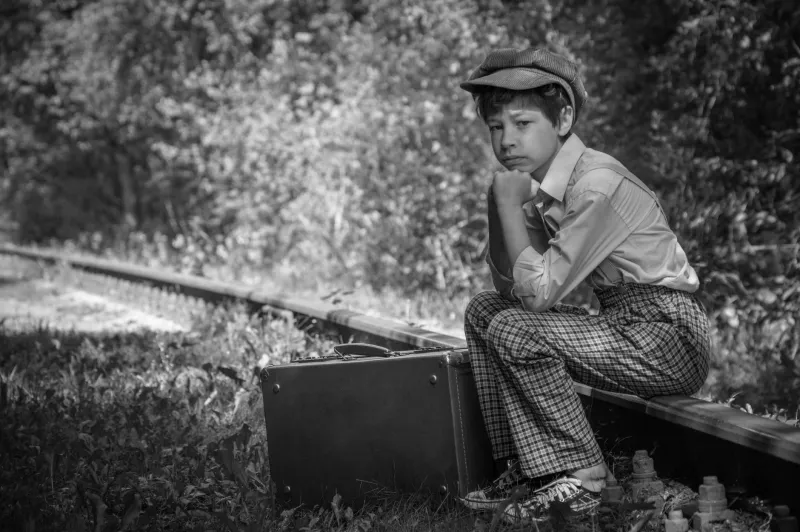
The Sound of Moving On
The train whistle that woke Jimmie Rodgers every morning wasn't an alarm clock—it was a lullaby he'd been hearing since childhood, the soundtrack of a life spent always moving, never quite settling, collecting musical fragments like a magpie gathering shiny objects.
 Photo: Jimmie Rodgers, via zlotynauczyciel.pl
Born in 1897 in Meridian, Mississippi, Rodgers grew up in the spaces between worlds. His father worked the railroad, which meant the family followed the tracks wherever maintenance crews were needed. Railroad camps were temporary cities, populated by men from everywhere and nowhere, each carrying songs from whatever place they'd left behind.
 Photo: Meridian, Mississippi, via www.exittoys.de
In these camps, a restless boy could hear Irish ballads from recent immigrants, work songs from Black laborers, mountain tunes from Appalachian drifters, and Mexican corridos from workers who'd followed the rails north. Nobody was protecting musical traditions or maintaining genre purity—they were just trying to pass the time between shifts with whatever songs they could remember.
Rodgers absorbed it all with the indiscriminate hunger of someone who understood, even as a child, that he might not have much time to waste.
Learning to Die in Public
By age thirteen, Rodgers was coughing blood. The diagnosis came without ceremony: tuberculosis, the disease that killed more Americans in the early 1900s than any other. In an era before antibiotics, TB was essentially a death sentence with an uncertain timeline. Some people died within months. Others lingered for years, growing steadily weaker until their lungs finally gave out.
The prescribed treatment was rest, fresh air, and acceptance of the inevitable. Instead, Rodgers did what he'd always done: he kept moving. If he was going to die young, he reasoned, he might as well die doing something interesting.
He worked railroad jobs when his health allowed, performed in medicine shows when it didn't, and gradually developed a reputation as someone who could entertain a crowd with nothing but a guitar and an inexhaustible supply of borrowed songs. He wasn't a virtuoso musician—his guitar playing was adequate at best—but he had something more valuable: the ability to make other people's songs sound like they belonged to him.
The Hybrid That Shouldn't Have Worked
In 1927, talent scout Ralph Peer was traveling through the South, recording local musicians for Victor Records. The country music industry, such as it was, had rigid expectations: white musicians played mountain music or old-time country, Black musicians played blues, and never the twain should meet.
Rodgers, dying by degrees and desperate for any opportunity, showed up at Peer's Bristol, Tennessee recording session with something nobody had heard before: a musical hybrid that mixed the yodeling of Alpine folk songs with the twelve-bar blues structure he'd learned from Black musicians in the Delta, all held together by the storytelling traditions of country ballads.
 Photo: Bristol, Tennessee, via cdn.heol.hu
By all rights, it should have been a disaster. The yodeling was too European for American audiences, the blues influence was too Black for white radio stations, and the whole combination was too strange for the conservative country music establishment.
Instead, it became the sound that defined American country music for the next century.
Racing Against Time
Rodgers' first recording, "Sleep, Baby, Sleep," was a modest success, but his follow-up, "Blue Yodel (T for Texas)," became a sensation that sold more than a million copies—an almost unimaginable number for a country record in 1928.
Sudenly, the dying railroad worker was the biggest star in country music, but success came with a cruel irony: the more popular he became, the sicker he got. Recording sessions became races against time, with Rodgers sometimes needing to rest between takes to catch his breath.
His songs began to reflect his condition. "TB Blues" was a darkly humorous meditation on dying young: "I've got the TB blues, I'm gonna die anyway." "Waiting for a Train" captured the rootless existence of someone who knew he'd never live long enough to put down roots anywhere.
But even as his body failed, his musical vision expanded. He recorded with jazz musicians in New York, Hawaiian steel guitarists in Hollywood, and Black blues performers in Dallas—collaborations that scandalized the segregated music industry but produced some of the most innovative recordings of the era.
The Blueprint in Blood
By 1932, Rodgers was dying in earnest, coughing up blood between songs and requiring oxygen between recording takes. His final recording session, in New York in May 1933, was a marathon of determination and desperation. He recorded twelve songs over three days, sometimes lying on a cot between takes, sometimes needing help to stand up to the microphone.
Two days after the session ended, Jimmie Rodgers was dead at thirty-five, having lived exactly the short, intense life that tuberculosis had prescribed for him.
But the musical DNA he'd created—that impossible combination of blues, country, folk, and pop that shouldn't have worked but somehow did—became the genetic code of American popular music. Hank Williams learned to yodel by listening to Rodgers records. Johnny Cash credited him as a primary influence. Even rock and roll pioneers like Elvis Presley and Jerry Lee Lewis grew up absorbing the musical hybrid that Rodgers had accidentally invented.
The Inheritance of Improvisation
What made Rodgers revolutionary wasn't technical skill or formal training—it was his willingness to ignore the boundaries that separated musical genres. Growing up rootless, dying young, and performing for audiences who didn't care about musical purity, he had the freedom to combine influences that more established musicians would never have dared mix.
His tuberculosis, the disease that should have silenced him, actually gave him a unique perspective on time and authenticity. Knowing he had only a few years to make his mark, he couldn't afford to worry about whether his musical combinations were "proper" or commercially safe. He just had to make them work.
The country music that emerged from his brief career was fundamentally different from the mountain music that had preceded it—more urban, more diverse, more willing to incorporate influences from across America's musical spectrum. It was music for people who, like Rodgers himself, were caught between worlds and making the best of borrowed time.
Still Moving
Nearly a century after his death, Jimmie Rodgers' musical DNA is still replicating itself through American popular music. Country, rock, blues, and folk all carry traces of the hybrid he created during his six-year recording career.
He never lived to see how his musical experiments would reshape American culture, never got the chance to settle down or put down roots. But perhaps that was the point—his music worked precisely because it came from someone who was always moving, always borrowing, always improvising, always running out of time.
In the end, the wanderer who never found a permanent home created the most durable blueprint in American popular music. Sometimes the most lasting contributions come from the people who know they won't be around long enough to see them through.