No Degree, No Credit, No Problem: The Woman Who Quietly Wrote the Playbook for American Business
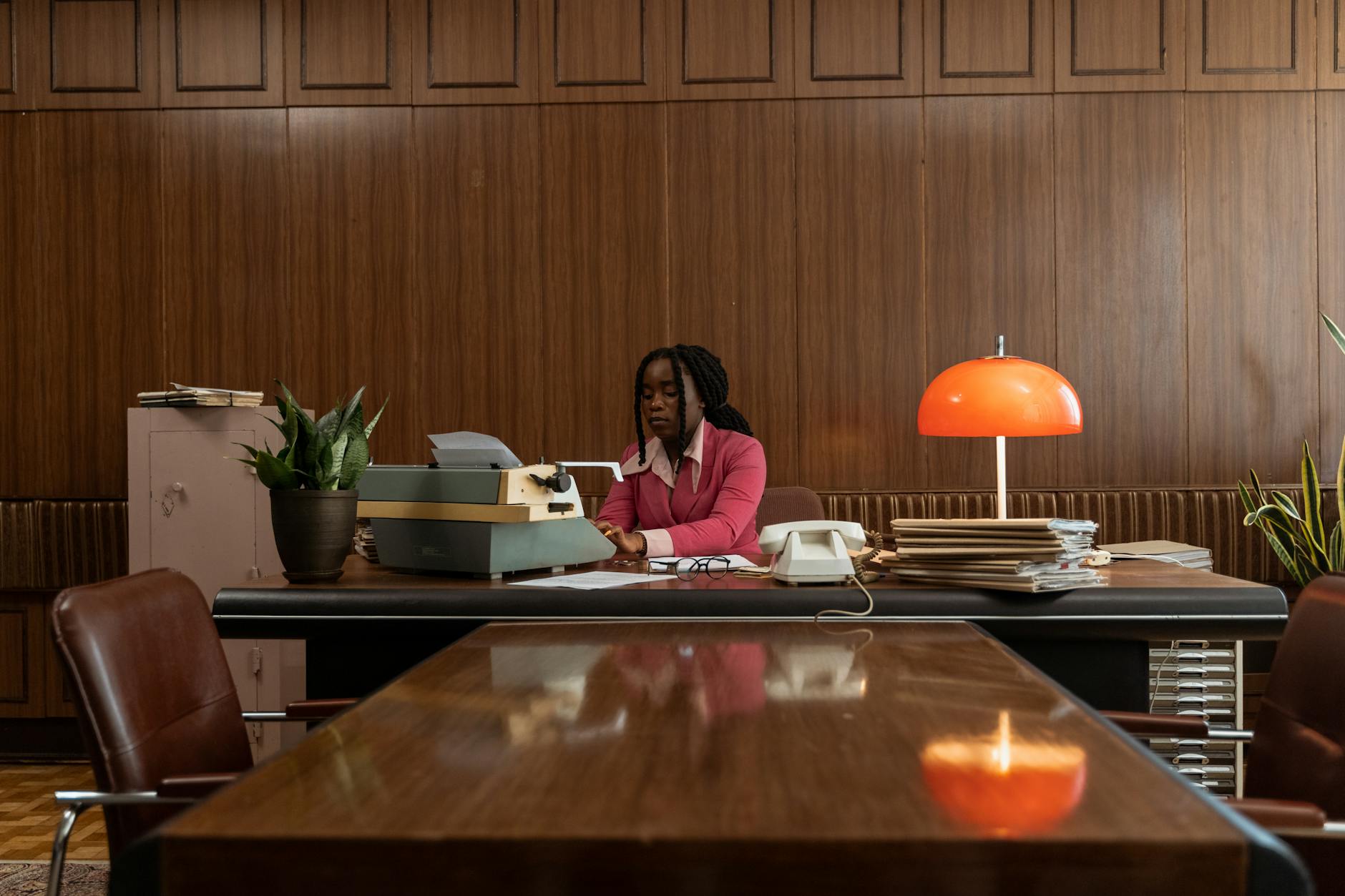
No Degree, No Credit, No Problem: The Woman Who Quietly Wrote the Playbook for American Business
Picture a Harvard Business School classroom in 1955. Crisp white shirts, the smell of chalk dust, a professor in a three-piece suit walking a room full of promising young men through a case study — a real-world business problem, dissected and debated until the room had wrung every lesson from it. It was, by that point, considered the gold standard of management education. Rigorous. Practical. Distinctly Harvard.
What that room didn't know — what it was never told — was that the woman who had done more than almost anyone to develop and systematize that methodology was sitting somewhere in midtown Manhattan, working without a title, without an advanced degree, and without the kind of institutional affiliation that would have made her contributions legible to the people who were benefiting from them.
Her name has been largely lost to history. That's not an accident.
A Different Kind of Classroom
She grew up in a working-class household where college was not a realistic conversation. This was the 1920s and 30s, and for a girl from her background, the expected arc was clear: secretarial school if you were ambitious, marriage if you were practical, some combination of both if you were lucky. Higher education — the kind that produced managers and executives and people whose ideas got written down and attributed — was for someone else.
But she was unusually good at watching how organizations worked. Not the org chart version of organizations — the real version. The way information actually moved through a company, who really made decisions and why, where the conventional management wisdom of the era broke down against the friction of actual human behavior. She noticed things that the men with MBAs, trained to see organizations as rational systems, kept missing.
She got her first real foothold in the business world through a clerical job at a mid-sized manufacturing firm in the early 1940s. Within three years, she was doing work that had no official name — interviewing managers, documenting processes, writing up what she called "problem narratives," detailed accounts of specific business challenges and how they'd been handled. She gave these documents to the firm's leadership. They used them in training sessions. The sessions worked.
The Framework Nobody Named After Her
What she was developing, intuitively and systematically at the same time, was a structured approach to learning from real business situations rather than theoretical ones. The idea wasn't entirely new — Harvard Business School had been experimenting with case-based teaching since the 1920s — but the specific architecture she built was different. She was less interested in famous corporate decisions made by famous executives and more interested in the granular, unglamorous problems that middle managers faced every single day: how to handle a supplier relationship that was souring, how to communicate a difficult personnel decision, how to allocate resources when every option was wrong.
Her case studies were messier than the Harvard ones. They were also more useful.
Through a network of contacts she'd built over a decade of work, her frameworks started circulating. A training director at one company passed them to a contact at another. A consultant who'd seen her materials incorporated them into a program he was selling to corporate clients. A professor at a regional business school used her problem narratives as the backbone of a course he'd developed and later published.
In almost none of these cases was her name attached.
What Outsider Status Actually Looks Like
There's a tendency, when we tell stories about outsiders who succeeded despite lacking credentials, to romanticize the outsider position — to suggest that being excluded from the establishment is somehow clarifying, that it frees you to see what insiders can't.
That's partly true. But it's worth being honest about what that freedom actually costs.
She could see what the credentialed insiders couldn't because she'd never been taught to not see it. She hadn't spent three years in a graduate program learning which questions were worth asking and which were considered beneath serious inquiry. She hadn't absorbed the unspoken rules about whose experience counted as data. Because she'd spent her career in the operational middle of organizations rather than in the executive suite or the academy, she had access to a kind of knowledge that was invisible to people who'd never worked there.
But that same position — operational, female, working-class, uncredentialed — meant that when her ideas traveled, they traveled without her. The business world of the 1940s and 50s had a very specific image of who produced knowledge worth taking seriously. She didn't fit it. So her ideas got absorbed and her name got left behind, and the men who built careers on frameworks she'd developed got to be the ones standing at the front of those Harvard classrooms.
The Texture of Invisibility
To understand what her daily reality looked like, you have to understand the particular texture of mid-century American professional culture.
This was a world where a woman in a business meeting was assumed to be taking notes. Where her ideas, floated in conversation, would often be restated by a male colleague two minutes later to general agreement. Where the question of whether she had a degree came up in contexts where the same question would never have been posed to a man doing equivalent work. Where "consultant" — the title she eventually claimed for herself — was considered a polite way of describing someone who hadn't been able to secure a real position.
She navigated this with what her few documented accounts describe as a kind of deliberate invisibility. She didn't fight for attribution in rooms where fighting would have cost her the access she needed. She let people believe what they needed to believe about where the ideas came from. She kept working.
It was a survival strategy. It was also, over time, an erasure.
What Got Built in Her Absence
By the mid-1960s, the case-study method had become so central to American business education that it was essentially synonymous with the Harvard MBA. The executives being trained through it — men who would go on to run companies, reshape industries, and write the management books of the 1970s and 80s — had learned through a pedagogical approach whose lineage they didn't know and weren't curious about.
The generation of CEOs who came out of those programs carried her thinking into boardrooms across America without any awareness that it had an origin outside the institutions that had taught them.
That's a strange kind of legacy. Pervasive and invisible at the same time.
What She Left Behind
She kept her own records. Boxes of them — problem narratives, framework documents, correspondence with the training directors and consultants and professors who'd used her work. When researchers eventually began piecing together the history of management education with more attention to its less celebrated contributors, those boxes became evidence.
Not vindication, exactly. History rarely offers that cleanly. But evidence that the story of how American business learned to train its leaders was more complicated, and had more authors, than the official version acknowledged.
She never went to college. She built the curriculum anyway. And somewhere in the gap between those two facts is the whole story of what it costs a society to decide, in advance, who gets to be the kind of person whose ideas matter.
The uneven path she walked didn't lead to recognition in her lifetime. But it left marks on the world that are still visible — if you know where to look.