The Great Escape
In 1926, Alexander Calder did what his respectable Philadelphia family considered unthinkable — he walked away from a steady engineering job to chase dreams of becoming an artist in Paris. His parents had watched him graduate from Stevens Institute of Technology, land work with the New York Edison Company, and seemed destined for the comfortable, predictable life that middle-class families prized. Instead, Calder packed his tools and headed for Montparnasse with barely enough money for rent.
The decision looked foolish to everyone except Calder himself. He'd been sketching since childhood, filling notebooks with drawings of animals and machines with equal fascination. His engineering training hadn't killed his artistic instincts — it had sharpened them. While other aspiring artists in Paris struggled to understand form and space, Calder approached sculpture like a problem to be solved, a system to be built.
Street Corner Genius
Paris in the 1920s was full of starving artists, but Calder found a way to eat that was uniquely his own. He began creating wire portraits of people on the street, charging a few francs to twist their likeness into three-dimensional form using nothing but pliers and wire. These weren't crude caricatures — they were sophisticated line drawings rendered in space, capturing not just facial features but personality and movement.
The wire portraits became his calling card in Montparnasse cafes. Other artists were impressed by his ability to see in three dimensions, to understand how a single continuous line could define a face, a gesture, an entire person. But Calder was just getting started. His engineering background meant he understood tension, balance, and structural integrity in ways that traditional sculptors didn't. He wasn't just making art — he was solving mechanical puzzles.
The Circus That Changed Everything
In 1926, Calder began work on what would become his breakthrough piece: a miniature circus complete with wire animals, acrobats, and performers. But this wasn't a static display. Calder performed with his circus, manipulating the figures to tell stories, creating an entire theatrical experience in his cramped studio. Word spread through Paris's art world about the American engineer who had built a circus that came alive in his hands.
The circus performances attracted everyone from Picasso to Mondrian. They came expecting novelty and found something revolutionary — an artist who understood that sculpture didn't have to be still, that art could move and change and respond to its environment. Calder's background in mechanical engineering meant he instinctively grasped concepts of balance and motion that other sculptors had to learn through trial and error.
When Art Learned to Dance
The leap from wire circus to mobile happened almost by accident. In 1930, Calder visited Mondrian's studio and was struck by the Dutch artist's geometric compositions. "I suggested to Mondrian that perhaps it would be fun to make these rectangles oscillate," Calder later recalled. Mondrian was horrified by the suggestion, but Calder couldn't shake the idea.
He began creating sculptures that moved — first powered by motors, then by air currents alone. Marcel Duchamp coined the term "mobile" to describe these new works, and suddenly Calder had invented an entirely new art form. The same mechanical intuition that had made him a competent engineer now made him a revolutionary artist. He understood how weight distribution affected movement, how air currents could be harnessed, how metal could be shaped to create specific types of motion.
The Unlikely Path to Immortality
What made Calder's success so improbable wasn't just his late start in art — it was how perfectly his "irrelevant" background prepared him for artistic breakthrough. His engineering training taught him to see problems as opportunities, to understand materials and forces in ways that purely artistic education never could. When other sculptors were bound by tradition, Calder was free to experiment because he brought tools and perspectives from outside the art world.
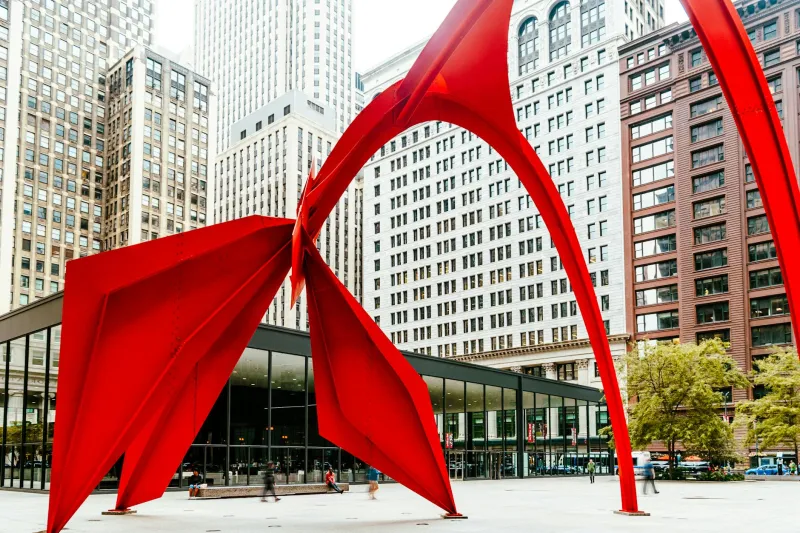
By the 1940s, Calder's mobiles were hanging in major museums worldwide. His large-scale "stabiles" — stationary sculptures that grew from the same principles — began appearing in public squares and corporate plazas. The man who had seemed to waste his technical education by running away to make art had actually found the perfect application for everything he'd learned.
The Mechanical Poetry of Motion
Calder's greatest insight was understanding that movement could be as expressive as form. His mobiles weren't just sculptures that happened to move — they were compositions in time, pieces that revealed different relationships and balances as they shifted. A Calder mobile in a museum gallery creates a constantly changing environment, casting moving shadows, creating new sight lines, transforming the space around it.
This wasn't possible without his engineering background. Calder could calculate exactly how different weights and shapes would interact, how air currents would affect movement, how to create sculptures that would move gracefully rather than chaotically. His technical knowledge didn't constrain his artistic vision — it liberated it.
By the time of his death in 1976, Alexander Calder had fundamentally changed how the world thought about sculpture. Museums, airports, and public spaces worldwide feature his work, and the principles he developed continue to influence artists today. The restless engineer who abandoned a conventional career to chase an impossible dream had succeeded beyond anyone's imagination — precisely because he never tried to follow anyone else's path to get there.