The Alabama Farm Boy Who Couldn't Catch a Break—Until He Caught Lightning in a Bottle
Cotton Fields and Radio Dreams
Sam Phillips learned about rejection before he learned to shave. Growing up on a tenant farm outside Florence, Alabama, during the Depression, he watched his father struggle to make ends meet while dreaming of something bigger than endless rows of cotton and borrowed money.
 Photo: Florence, Alabama, via img.groundspeak.com
Radio was Sam's escape. Every night after chores, he'd tune into distant stations, marveling at how voices could travel hundreds of miles through invisible waves. By age fourteen, he'd built his own crystal radio set from scraps and decided that somehow, someway, he was going to work in that magical world of sound and music.
But wanting something and getting it proved to be entirely different challenges.
The Audition Circuit of Humiliation
After a stint as a radio operator in World War II, Sam returned to Alabama with big dreams and bigger ambitions. He packed his few belongings and headed to Nashville, convinced that his technical skills and musical instincts would open doors in the country music capital.
Instead, he found a brick wall with his name on it.
Every major label turned him down. RCA laughed him out of their offices. Columbia wouldn't even grant him an interview. The problem wasn't his technical ability—Sam could operate recording equipment better than most professionals. The issue was his taste. He kept talking about "raw" sound and "authentic" voices while the industry was moving toward slick, polished productions that sounded like they came off an assembly line.
"Son, you need to understand that people want music that sounds professional," one A&R executive told him after a particularly brutal rejection. "This rough stuff you're talking about—nobody's going to pay money for that."
Memphis: Last Stop Before Giving Up
By 1950, Sam was nearly broke and ready to abandon his music dreams entirely. But Memphis offered one last opportunity—a chance to open his own small recording studio, financed with borrowed money and boundless optimism.
Sun Studio opened on Union Avenue with a simple mission statement: "We Record Anything—Anywhere—Anytime." Sam couldn't afford to be picky about clients. He recorded wedding ceremonies, funeral services, local bands, and anyone else willing to pay five dollars for a session.
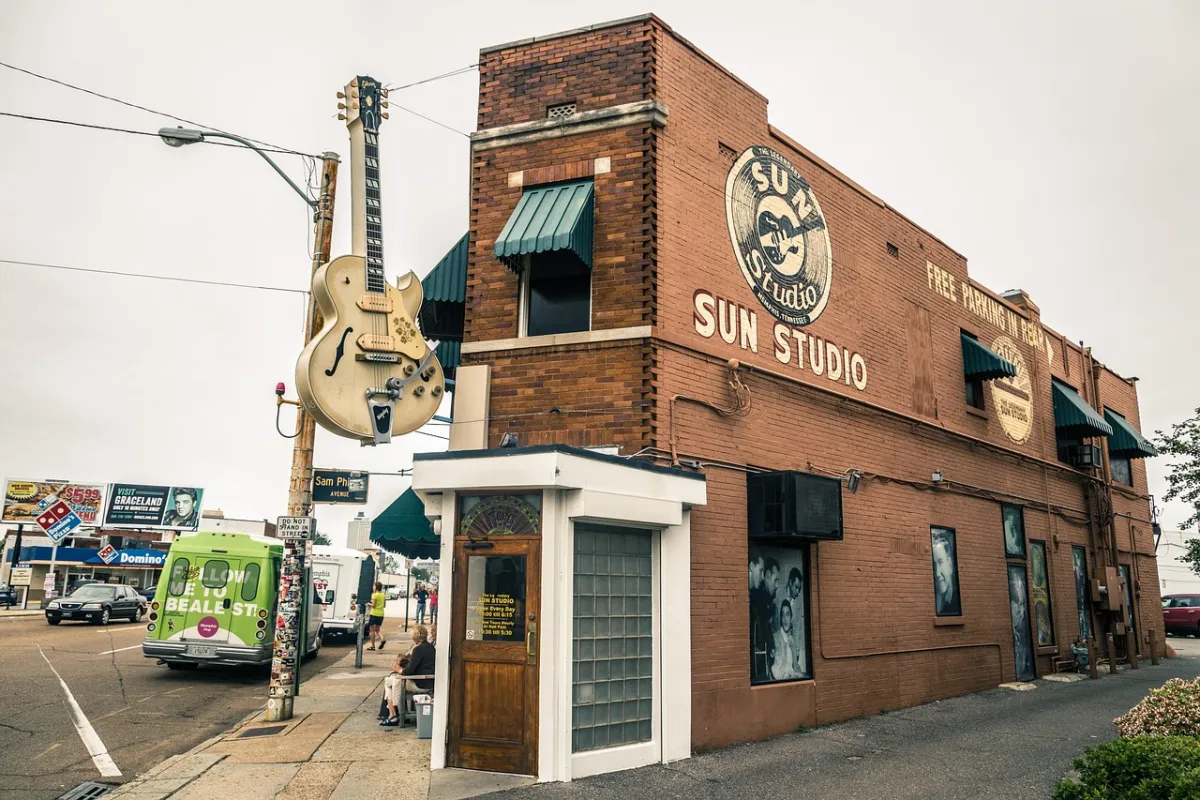 Photo: Sun Studio, via cdn.pixabay.com
Most industry professionals would have seen this as failure—reduced to recording amateur hour in a converted radiator shop. But Sam's years of rejection had taught him something valuable: the music business didn't know what it wanted until it heard something it had never heard before.
The Sound of Authenticity
What made Sam different wasn't his equipment or his technique—it was his ear. Years of being told his instincts were wrong had actually sharpened them. While major labels were perfecting their formulas for commercial success, Sam was learning to recognize something else entirely: the sound of real human emotion.
He developed a recording philosophy that was revolutionary in its simplicity. Instead of trying to eliminate the imperfections in a performance, he enhanced them. The slight tremor in a voice, the squeak of fingers on guitar strings, the ambient noise of a small room—these weren't flaws to be corrected, they were the essence of what made music move people.
Local musicians began to notice something different about Sun Studio recordings. They sounded alive in a way that major label productions didn't. Word spread through Memphis's musical underground that there was a guy on Union Avenue who could capture lightning in a bottle.
The Accidental Revolution
Sam's breakthrough came through a series of accidents and instincts that no business school would have recommended. In 1951, he recorded a local group called The Kings of Rhythm performing "Rocket 88"—a raucous, high-energy song that would later be called one of the first rock and roll records.
The recording session was chaotic. The guitar amplifier was damaged, creating a distorted sound that any professional engineer would have tried to fix. Instead, Sam leaned into the distortion, recognizing that it added an edge and urgency that perfectly matched the song's energy.
When "Rocket 88" became a hit, Sam realized he had stumbled onto something bigger than a single song. He had found a sound—raw, immediate, and emotionally honest—that connected with audiences in ways that polished productions couldn't match.
The Discovery That Changed Everything
By 1954, Sam had refined his approach and was actively seeking artists who embodied his aesthetic. When a shy nineteen-year-old named Elvis Presley walked into Sun Studio to record a birthday song for his mother, Sam heard something that confirmed every instinct his years of rejection had taught him.
Elvis wasn't technically the best singer Sam had ever heard. His voice cracked occasionally, and his style was an unusual fusion of country, gospel, and rhythm and blues that didn't fit any established category. But he had something that perfectly crafted performers often lacked: authenticity that came through in every note.
The recording session that produced "That's All Right" was loose, experimental, and completely unlike anything major labels were producing. It was exactly the kind of "unprofessional" sound that had gotten Sam laughed out of Nashville offices years earlier.
This time, the world was ready to listen.
The Uneven Path to Revolution
Sam Phillips's journey from Alabama farm boy to rock and roll pioneer illustrates how failure can be the best teacher. His years of rejection forced him to develop an independent aesthetic that proved far more influential than any major label formula.
The man who couldn't get hired by the music industry ended up reshaping it entirely. His "failed" approach to recording became the template for rock and roll, influencing everyone from The Beatles to Bruce Springsteen.
Lightning in a Bottle
By the time Sam sold Elvis's contract to RCA in 1955, he had already launched the careers of Jerry Lee Lewis, Carl Perkins, and Johnny Cash. Each artist represented his philosophy of authentic expression over technical perfection.
Sam's legacy extends far beyond the artists he discovered. He proved that innovation often comes from the margins, from people who have been rejected by established systems and forced to create their own alternatives. His uneven path from cotton fields to recording revolution reminds us that sometimes the most important breakthroughs come from those who couldn't catch a break—until they learned to make their own.
The Alabama farm boy who was too rough for Nashville created the sound that made Nashville irrelevant. His story proves that when the industry won't let you in through the front door, sometimes you have to build your own building—and change the neighborhood forever.